A pair of recent Derry-Londonderry productions set their sights on real history and reel history respectively
If you told me that the theatrical landscape in the still very recent City Of Culture felt a little bit barren nowadays, I'd say you wouldn't be far wrong. The city's theatre goers were frankly spoiled for choice in the years leading up to and the closing months of 2013, if not slightly beyond that. Back then, it was not uncommon to take theatrical spectaculars for granted, considering the apparent richness of the cultural landscape in the North West.
But while the money may no longer be available, at least not to the same extent, the area continues to thrive artistically, with talent both established and burgeoning keen to exhibit their skills on and off stage. Nowhere is this more visible than in a pair of recent plays performed inside and outside the city's walls. One sets its sights on real history; the other has fun with reel history.
The set design in Carlo Gebler's Walking To The Ark, directed by Kieran Griffiths, is symbolic of both history and the present day, the bumpy wooden path which separates a stately living room and a prison cell metaphorically representing the rocky travails between the bottom and top rungs of society. This is the gap between those in comfort outside the walls and those entrapped within them during the Siege Of Derry in 1689, Gebler's source of information and inspiration for the script.
Walking To The Ark's historical background revolves around the story of Williamite Colonel Thomas Whitney (Peter Hudson), his mistress Martha Darcy (Tara Breathnach) and their imprisoned, illegitimate son, the Jacobite Captain Nicholas Darcy (Dermott Hickson), giving additional resonance to a thoughtful, edgy and verbose play. The narrative, non-linear, torturous but tightly-paced, is guided humanely by Griffiths to a powerful conclusion.
Gebler's vocabulary and Griffiths' direction are ideal for Tara Breathnach, who utterly excels as Martha. At first, she is an excitable, nonsensical, even flirty mess, but Breathnach compellingly unveils the enslaved and frustrated soul within, mastering the character and capturing our attention. When she tears a Bible to shreds and hides the pages away, reflecting absorption of all guilt and regret, it is the epitome of the role and her performance, spectacularly mirroring Martha's fury and despair. Even when Peter Hudson's Thomas undresses her, she gives no quarter, her vulnerability only exposing itself once her son's situation is unveiled before our eyes.
The heart of the production lies in and emerges from the general confines of Nicholas Darcy's prison cell, watched over by Pat Lynch's creepily amusing Turnkey. While Nicholas's frustrations mirror Martha's, Turnkey, as the middle man between authority and prisoner, gradually develops from stereotypically wisecracking to the voice of reason he initially purports himself to be. The roles and positions of the colonel and captain change, Martha's agony intensifies, and Turnkey's wisdom grows, in a society that literally and fundamentally hangs by a red thread of clothing. Once again, it's metaphorical, of the ever-thinning bloodline that strains to connect a mother, father and son searching for both family and liberty. And you can't help but hope that this particular thread strengthens rather than snaps.
Blood - of the fake kind, thankfully - is everywhere to be found when the North West Regional College travel back in time to take on Quentin Tarantino's Reservoir Dogs. The difference between film and play is simple, yet effective; newcomers have the chance of enjoying the 1991 classic, generally adapted word-for-word, from a more youthful angle and intimate point-of-view. Like Walking To The Ark, you need not be familiar with the source material or the inspiration to fully appreciate it.
The NWRC theatre is converted into a direct replica of the film's abandoned warehouse hideout. A table & chairs, live band and pre-recorded film & audio are also used as every single one of the film's iconic scenes are brought to life, if not necessarily in the order and manner you may expect.
For here, every single one of the coded gangsters are played by women. Amy McLaughlin, Jessica Shaw, Kristian Logan, Andrea Nic Eimeid and Clare Sweeney step into the shoes of Blue, Brown, Blonde, White and Pink respectively alongside Oisin McCool's Joe Cabot and Ryan McGlinchey's Nice Guy Eddie, while Mary Crossan & Niamh Gaffney do double duty as the partly all-action, partly heavily wounded Orange.
The solid directorial hands and heads of Liam Craig & Michael Poole point the young cast in the right direction, Sweeney, Nic Eimeid and Logan especially impressing. On the whole, Tarantino's ability to indelibly, excitably merge everyday nothings with potentially stomach-turning violence is efficiently and effectively embodied. Needless to say, these Reservoir Dogs have plenty of bite.Read more...
A one-man rock music play achieves pointed resonance through passionate performance
A winsome one-man spin on a popular formula, Eaman Craig's EXiT, directed by Colm S. Herron, hits the spot by opening up every beat in the book of the washed up, conflicted rocker in a tried, trusted but effective manner.
As the symbolically named Jonah Walker – someone trapped in a big, bloated whale of an industry who also looks tempted to walk away from it all – Craig is the personification of relatably restrained acceptance with occasional outbursts. Walker is part flamboyant, part ruffian, defined by his unshaven, unkempt, burnt out yet white suited appearance. Like a cross between Freddie Mercury at his peak and a young, hungover Roger Daltrey.
Patiently, and worryingly, Walker pours out his heart and his thoughts to the audience on a quest to find his bearings and recover his sanity. In a quest for freedom, creatively and relatively, he initially struggles to distinguish objects from humans, talking to a Henry hoover as if it is a real person and likening past girlfriends to record companies. He is wrestling with the decision to join a record company or stay independent, and Craig delivers Walker's words with a cutting, direct precision, getting to the heart of his character's dilemma and state of mind.
The varying paths of a musician, both as a person and an artist, are concisely documented and well expressed through numerous moods, memories and musings, which you almost certainly suspect will result in new lyrics if not a new deal for the mixed-up Walker.
EXiT contains plenty of wry humour, mainly arising from Walker's mimicry of others and his mockery of what people perceive him to be. It's just one part of the frustrated pressure cooker building inside Walker, which near the end, leads to his biggest rant of all: a scathing swipe at the prominence of reality shows, where contestants' dreams amount to little more than half decent cover versions. It's common sense, of course, but Craig is so passionate that he achieves the pointed resonance that we seek and Walker is searching for.
Perhaps more, too, as Craig's mere references to these supposedly star-making shows prompt a timely and necessary warning about becoming drenched in nostalgia. Unless, that is, something is done about it. And perhaps, if Walker finds his way again, he may well be able to do something about it. At least in his own life.
The success of Mamma Mia! has proved that the jukebox musical is alive and well. But is that a good thing?
To get to the point, the latest production of Mamma Mia!, premiered at Belfast's Odyssey Arena on Tuesday June 16, was a delight.
The choreography was first rate, the sets were economical yet effective, the spot effects, when called upon, were stellar, and the acting was, as to be expected, superb, with Niamh Perry's commandingly cheery chirpiness the highlight.
The Bangor girl, once of BBC's I'd Do Anything, took to the role of Sophie like a duck to water, thriving on being the centre of attention in a choral cascade of chaos.
Once the audience lost themselves in the oh-so-familiar ABBA tunes, there was no looking back. I found myself singing along to "Take A Chance On Me", "Super Trouper" and "Knowing Me, Knowing You", and I'm not even an ABBA fan.
Like Grease, literally and figuratively, ABBA stick to you whether you like it or not, and the all too brief buzz gained from watching this musical was equally effective. It was a hugely pleasurable evening.
But. But. But.
If jukebox musicals give us so much momentary joy and excitement, what else is there to think about? Their plots feel entirely irrelevant. No one who goes to a jukebox musical seems to even consider plot, which is arguably why it's a generally reviled genre amongst the most highbrow of critics. (And one that Birdman's Riggan Thompson wouldn't even consider.)
Those who attend the Mamma Mias, We Will Rock Yous and Tonight's The Nights of this world get most pleasure from singing the songs they know so well, which are carefully, calculatedly wrapped around a narrative thread that doesn't appear to matter at all. Popular tunes sell, and you sense the producers know it, in the sort of production that feels less about art and more about business.
A jukebox musical comes across as not so much a theatrical experience as a lively recreation of a rock concert or disco. That was never more apparent than during the excitable yet uneasy encore, where a slickly choreographed Waterloo awaited us: an ABBA song that had absolutely nothing to do with the show itself.
What its presence did was ensure that every single track on the ABBA Gold: Greatest Hits compilation featured on the night. (It's true: you can check the track listing for yourself after you've seen the show.)
Hence it was, and is, hard not to feel cynical about every single well known ABBA tune being shoehorned into the script for the sake of instant, easy joy and happy clapping.
As an aside, I should point out that my favourite musical is 1999's South Park: Bigger, Longer And Uncut, which was both a parody and a great piece of musical film in itself. It's always a delight to come across a musical that marries a genuinely humorous plot to original tunes, and South Park did just that, Marc Shaiman's songs paying homage to and satirising the classic musicals of the past in addition to maintaining their edge. ("La Resistance" was, and still is, a fantastic take on Les Miserables' "One Day More".)
Having said that, not every musical needs to have edge, or depth. And when done right (Teenage Kicks: you should have taken note!), jukebox musicals can really elevate your spirits, even going so far as to reawaken your passion for a band you once liked but tired of.
And as refreshing as South Park and its ilk may seem, the “know what you'll get” feel of jukebox musicals can be equally refreshing. We might not wish for them to be the norm – I, personally, fear that Every Little Thing She Does Is Magic: The Musical will be in the West End before we know it – but the odd jukebox musical never hurts. In fact, it helps.
So hats off to everyone involved in Mamma Mia! You put on a great show. But let it not be the be all and end all of musical theatre. This genre has much more to offer than even its supporters may think. Mamma Mia! runs at the Odyssey Arena until tonight, June 20, before playing at Bord Gais Energy Theatre, Dublin from June 23 to July 4, and the Millennium Forum, Derry-Londonderry, from July 7 to 11. For details and booking links, visit www.aikenpromotions.com.Read more...
NI's Big Telly Theatre Company bring another collection of oddballs and eccentricities to the stage, to sublime effect
One cannot consider the work of Northern Ireland's Big Telly Theatre Company linearly. Linearly, their productions are as coherent as a malapropism, as bumpy as a dusty country road and as unsettling as the most enduring horror movies. But it is precisely because of these qualities that everything they do achieves a sort of timelessness. Three years ago they amused and bemused us with the baffling, off-the-wall yet unforgettably brilliant Melmoth The Wanderer, and their One Sandwich Short Of A Genius – hereafter One Sandwich – is no different: the title is as nonsensical as the narrative appears, but the overall effect is memorable, even sublime.
Central to One Sandwich is the nuclear family gone wrong, the typical dysfunctional family found in The Simpsons, Family Guy and just about every modern day sitcom imaginable, presented to the viewer through a fresh and unexpected prism. All at once, One Sandwich is melodramatic, comedic, reflective, self-reflexive, frightening and musical, a melange of genres sprung in our faces haphazardly yet hilariously. Five, strong-willed, expressive actors – co-writer Shelley Atkinson, Patrick J. O'Reilly, Claire Lamont, Michael Diana and Conor Grimes – give it absolutely everything they have, taking their respective archetypes – the manipulative mother, the sporty son, the highly-strung daughter, the father figure and the mystery man – and peeling away their layers delectably and deliriously.
This tale, about a family who allegedly have nothing to lose but in reality have plenty, is the kind that keeps everyone in the theatre on their toes. Most fascinating of all is the matriarch herself, June Evelyn Talbot. As portrayed by the simply fantastic Shelley Atkinson, June is a mother of outlandish questions, reprehensible actions and literally keeping up appearances: in other words, Hyacinth Bucket gone haywire. Atkinson's stately, pronounced and sometimes shrill line delivery goes hand in hand with consistently creepy expressions, resulting in a revelatory comic creation. She's the sort of person you wouldn't want in charge of anything, let alone the biggest day of your life. Yet that's exactly what June's son and daughter have to deal with when their mother tries to organise their life and marriage respectively!
Little wonder, then, that One Sandwich is so chaotic. Yet it is also rather relatable. When watching these individuals, audiences will surely sympathise with anyone who attempts to maintain their sanity amongst the collection of oddballs in front of them. Classic pop songs feature extremely randomly, both fourth walls and characters' hearts are broken, literally and figuratively, and when the theatre lights switch on and the final bows have taken place, one is left contemplating a play that riskily straddles the line between serious theatre and prim pantomime... and, thanks to the dedication of director Zoe Seaton and the cast, gets away with it. For all of its confused comedy, for all its intelligent, idiosyncratic incoherence, One Sandwich Short Of A Genius could well be the ultimate and most ultimately rewarding statement on the trials and tribulations of the nuclear family.
One Sandwich Short Of A Genius will be performed at Armagh's Market Place Theatre on April 4. For more information, click here.Read more...
The Londonderry Musical Society push boundaries and thrill audiences in their latest production
It's the LMS, Jim, but not as we know them. For more than half a century, the Londonderry Musical Society have taken pride in both matching and exceeding the expectations of musical theatre lovers everywhere. But most recently, they’ve gone further and subverted them. Last year, the intimately theatrical, partially horrifying and dramatically moving Jekyll & Hyde cemented the LMS as a new kind of force: experimental and adaptable, without abandoning their usually high standards of entertainment. With The Best Little Whorehouse In Texas – a suggestively dubious title in itself – they've taken subversion all the way, yet remained true to their proud history. It's a remarkable production.
The Best Little Whorehouse In Texas is based on the true story of a legendary Texas brothel known as The Chicken Ranch, which thrived under the unofficial blessing of the local authorities until a Houston television commentator set out to expose it and shut it down. It's as close as the LMS has ever gotten to adult humour and downright raunchiness, with push-up bras, thrusting and swear words seen and heard. If director Deigh Reid's intention is to make you feel like you're in the titular “whorehouse”, he's done just that, with suggestive, knowing poses and a cascade of colourful costumes (and sometimes language) raining down on the audience throughout the entirety of the first act. Not everyone might know what to make of it, but it is guaranteed to linger long in the minds of the watchers.
As are more than a handful of the show tunes. 24 Hours Of Lovin' is performed with a decidedly Aretha Franklin-esque air by the calmly sassy Penny McGonagle, the brilliant Katie Patton gets her moment in the spotlight with the Doatsey Mae song (even if her character has not yet been fully established), The Aggie Song is hilariously choreographed, The Sidestep is delightfully catchy, and every single one of Mona's songs are performed confidently and soulfully by the leading lady and her girls. Mona herself, Muire McCallion, is the clear standout in a superb cast, her mannerisms and singing voice tying in perfectly with the character's nature. That's to be expected.
What's not so expected, without going into specifics, is the grim turn the show takes in the second act, unveiling humanity in characters that we wish we’d gotten to know better. A fun, risqué romp becomes darkly devastating (and eerily timely with arts cuts everywhere, every when), unveiling The Best Little Whorehouse In Texas to be about the pros and consequences of "letting your hair down" in a society and atmosphere that is more conservative than you'd like it to be.
The Best Little Whorehouse In Texas runs until Saturday March 28 at Derry-Londonderry's Millennium Forum. Book tickets here.Read more...
For their 14th annual Christmas panto, Derry/Londonderry's Millennium Forum has concocted something of a comic and musical cabaret.
Writer and producer David McLaughlin has tied the classic Jack and the Beanstalk narrative to a succession of popular tunes, situational sketches, topical humour and accidental (surely?) innuendos.
On paper, it could pan out as predictable, but on stage, it works tremendously well. Helga Wood’s designs are colourful and inventive, the ideal backdrop and accompaniment for costumed giant Blunderbore, costumed cow Daisy, and an energetic, interactive ensemble of dancers, singers, actors and comedians.
Above all, the cast elevate this production by consistently maintaining a warm-hearted, genially humorous and largely hyperactive tone.
The big production numbers do not disappoint. Orla Mullan's charmingly graceful Fairy Rose Petal raises the roof with "Skyfall"; Conor O’Kane’s Jack and Kathryn Rutherford’s Princess Jill delicately duet Duran Duran’s "Ordinary World"; and reliably pivotal Panto Dame William Caulfield enjoys a hilarious take on the "Scooby Doo" theme with Gerard McCabe’s Silly Billy and James Lecky's king.
Most inspired is the decision to give the giant a lieutenant: Keith Lynch's Flesh Creep. By sidestepping brooding intimidation for hammy comedy, Lynch creates a highly amusing, obstructive nuisance of a villain – the best thing in the show.
Verdict: Energy, charm and heart successfully combine for a highly enjoyable pantomime.
This article was originally published in The Stage in December 2014.Read more...
Read reviews of three Northern Ireland pantomimes - a colourful, charming adventure, a "most amoosing" feast of fun, and a novel, playfully entertaining journey
ALADDIN (Grand Opera House, Belfast)
A curtain cast in glitter rests upon the eyes of a buzzing, chattering, excitable audience of all ages as John "May McFettridge" Linehan's 25th appearance in the Grand Opera House Christmas pantomime begins.
Accompanied by the likes of former Steps singer Faye Tozer, world renowned ventriloquist Jimmy Tamley and local actress Jayne "Sweeney Todd" Wisener, Aladdin promises a colourful cascade of gaudy theatricality for the whole family. On that count, it doesn't disappoint.
Of course, it's a nonsensical, anachronistic stew. How can it not be? But it is a rather enjoyable one. It opens on a perfect note, with self-titled "chosen one" Aladdin, played by Aaron Hayes Rodgers, leading a superbly choreographed take on Pharrell Williams' "Happy". Energetic, lively, vibrant and vivid, it's the ideal door opener for McFettridge to pull out all the stops on this occasion - his occasion.
Cheap and local situational humour of the verbal and physical kind are tossed into a casserole of sometimes charming and sometimes catastrophic charades, played to the hilt by McFettridge and her, or his, animatedly affable ensemble.
Predominantly doused in fluorescent light, and surrounded by commendably detailed set design, the cast and chorus pack in as much lightly lateral and all-too-obviously literal banter that the framework of the classic Aladdin story allows, some of it raising more laughs than others. This version of Aladdin is ultimately at its best when its stars are given the freedom to show off their not inconsiderable skills, which is relatively frequently.
Jimmy Tamley and his puppets are a hoot, while as enchantress Scheherazade, Faye Tozer keeps you on your toes, alternately pleasing with her engaging expressions and powerful pipes.
On stage, Tozer is a perfect counterpoint to Earl Carpenter's evil Abanazar. Like Ralph Fiennes or Alan Rickman with a clownish bent, Carpenter is intimidating yet inept, a true pantomime villain that the children can really enjoy booing or hissing at.
And while Carpenter and Tozer somewhat overshadow the antics of Aaron Hayes Rodgers' title character and Jayne Wisener's Princess Jasmine, Hayes Rodgers' schoolboyish enthusiasm and Wisener's sweetly mellow perkiness are strong enough to win the audience over.
Amidst all the comedy and choreography, there's also room for two more marvellous technical visuals - the sight of Aladdin "soaring into the air" on a magic carpet, and an animatronic King Kong-esque figure that leads to a highly amusing sketch involving apes and bananas. It's a worthy celebration for May McFettridge, and a pleasing reminder that all that's glitter can be some kind of gold in the right company and with the right personnel.
(The original version of this review appeared in the Belfast Telegraph on Wednesday December 3, 2014. It can be read here.)
JACK AND THE BEANSTALK (Millennium Forum, Derry-Londonderry)
"Sit back, clap your hands, stamp your feet and let the show begin." So proclaims Panto Dame William Caulfield as the hitherto mild-mannered Derry-Londonderry audience prepare to be sucked into Jack And The Beanstalk, a passionately performed feast of fun and frolics which does not fail to impress.
The tempo is steady and true as Good Fairy Rose Petal, played by Orla Mullan, and Evil Flesh Creep, played by standout performer Keith Lynch, narrate the prologue in comic verse as a prelude to the first of many popular songs seamlessly integrated into this sketch show, love story and fairy tale rolled into one.
This tale of evil giant Blunderbore and hero Jack's quest to bring him down in the land of a bumbling king, a sweet princess, a snidely, snooty, buffoonish villain and a loveable cow named Daisy, is showered in a series of cracking choreography and charming comedy. The duets are strong and clear, not a bum note is hit during the dances, and Caulfield forms a good dynamic with everyone in the Forum, particularly Gerard McCabe's Silly Billy.
The sets are cartoonish and colourful, giving the feeling of being enveloped in a hyperactive comic book. Naturally, the faithfulness to the story means a little sap, but the overall tone is so winning that this is more than forgiveable.
And yes, the presence of the costumed cow is most amoosing and the cast milk it. With its experienced talent, winningly fresh faced youth and bunch of bumblers game for a laugh, this is a classically warm-hearted community panto, a real treat.
(The original version of this review appeared in the Belfast Telegraph on Friday December 5, 2014.)
SLEEPING BEAUTY (Lyric Theatre, Belfast)
With all the big, brash pantomimes around, how about a warmer, more intimately theatrical alternative? That's what writer Derek O'Connor, director/choreographer Deborah Maguire and the cast and crew of Sleeping Beauty seemed to offer the wet, shivering yet spirited souls who trundled up the Lyric's stairs. They were not to be let down.
How, one wondered, could O'Connor set this well told fairy story apart from its previous incarnations? His modus operandi is to "(make) the journey as much fun as possible", and, true to his word, the first quarter of the play was an utter delight – no "getting to know you" period, just a surprisingly fast-paced, colourful "in your face" concoction of natural humour, post-modern irony, original tunes and deft dancing. It leaves viewers keen to see more of this "Lost Kingdom" and its king, prince, princess, evil witch, good fairy and rather dazzling special effects.
Complemented by a tuneful score, the never really frightening yet always playfully entertaining production - because isn't that what panto should be? - features three particularly striking performances. Richard Ashton is fun to watch as the king, the impressive Jo Donnelly booms and hollers her way out of Maleficent's shadow, and the cheery chirpiness of Kathryn Aiken's fairy Firefly pumps the production with life at the most timely of moments. (The original version of this review appeared in the Belfast Telegraph on Thursday December 11, 2014. It can be read here.)Read more...
Tristan & Isolde meets Isaac Asimov in Dave Duggan's dystopian play
"It's only chaos out there."
So speaks a confused looking girl in bleak surroundings that match the stiltedness of her speech. These are the words of Makaronik, portrayed superbly by Liz Fitzgibbon in Dave Duggan's equally superb play of the same name. Inspired by the words of George Orwell's 1984, the themes of Isaac Asimov's I, Robot and the tone of the legendary tale of Tristan & Isolde, the power of Duggan's pen has passed from page to stage to create a multi-lingual, theatrical experience like few others of recent times.
Set in a degraded data centre, a refuge amidst the virtually insane backdrop of 2084 Belfast, Makaronik depicts a tale of two visitors to the title character: Diarmuid (Cillian O'Gairbhí) and Gráinne (Mary Conroy). Named in a reference to the love triangle between two identically named characters in a mythological Irish prose narrative, the obstacles this Tristan and Isolde face are more than just about love.
Diarmuid and Gráinne are officers in an Imperial Empire where language after language has been outlawed. Languages are seen as “threats to the Empire” at a time where Belfast is not a communal city but a soulless unit. It's a scenario as twisted as macaroni (naturally): individual identities ignored for the sake of replication in the form of neutered "drones". Makaronik is one of these, the last of her kind, assigned to take care of things until Diarmuid and Gráinne arrive to take every last shred of data, and Makaronik herself, back to the centre of the Empire.
Aspects of Irish, English and even Latin merge into the one language that can possibly be spoken in this wreckage: Empirish, a hodgepodge of gibberish as oppressive and restrictive as the setting. Restrictive not by way of communication, but by way of expression. To Makaronik, the data in the centre is her means of "breaking free" - Shakespeare, National Anthems and all other kinds of theatre, literature and music have seen her transcend the boundaries of any drone and emerge as an emotive, educated human being.
Deciding what to do about Makaronik is a problem for Gráinne and Diarmuid, who, while getting by solely on scraps of knowledge picked up from elsewhere, are also fearing for their own safety while pondering if they will ever be allowed to be together, as Tristan and Isolde never were. To Gráinne, completion of their duty will lead them to safety at the centre of the Empire. To Diarmuid, it seems apparent that this little centre will see them enjoy the only true companionship they will ever get. They feel stranded, yet safe. It is an abstract, serious yet passionately intricate situation, made decipherable to the audience by firstly, the acting, and secondly, by twin on stage screens that subtitle the on-going affairs of the three characters.
But nothing fascinates more in Makaronik, at least in my view, than the title character. It's impossible to ignore her android like tendencies: like any Asimov prototype, or, more famously, Star Trek's Data, she appears to absorb every fact that she is exposed to. There is also a servile slant to her character in that, when Gráinne later makes a decision to remain at the data centre, she is confident that Makaronik will look after her: meaning that Makaronik shows no ill will towards the two officers. In that respect her behaviour is more human than that of her colder, more methodical guardians. Quite probably, both Diarmuid's and Grainne's moods have been deadened as much by the feelings they are not allowed to feel as by Makaronik. Her uniqueness drives a wedge between them: she is like a star child, one who can protect and must be protected.
And when Makaronik bursts into tears at the thought of leaving her centre, her superficially robotic facade is shattered and the heart of the play emerges in this mischievous, knowing, enigmatic soul. She is less Data and more Mrs. Spock without the pointed ears. We are absorbed by her absorbance and her remarkable ability to see the world in a way others do not. She is no android, nor is she an alien: she is just alienated in an alien nation, trapped in an empirical hub that she cannot, and surely we could not, adjust to.Read more...
Derry-Londonderry's Echo Echo Dance troupe present an educational and interactive feast of fun for adults and children
In the very centre of Derry-Londonderry on a cold, wet and windy November night, there's a brick building not far away, right on the city wall, where dancing girls will strut their stuff and edify us all.
With apologies to Cecil Frances Alexander, the second half of that sentence may well be the motto of the Echo Echo Dance Ensemble, a collection of nimble and expressive young ladies who are embarking on their second annual Festival Of Dance And Movement.
Opening night sees the first of two performances of Ludo Lusi Lusum, a composition for children and adults directed by Ayesha Mailey and performed by Esther Alleyne, Janie Doherty, Kelly Quigley, Zoe Ramsey and Tonya Sheina. The title of three Latin words translates as "play, imitate, deceive" or "sport, banter, delude", depending on your preference, and this is exactly what we're going to see: a play on words and pictorial expressions through deceptively simple imitation of other forms of life. In other words, impressionist animalistic charades.
The first two thirds of the piece are a panorama of choreography and mimicry, an interactive game of Pictionary for both cast and audience. Ramsey stands out as a part-feline, part-canine werewolf, her whines, pants and growls the response to disciplined, direct orders from two other cast members. She's also called upon to pose as fruits, including a grape and a banana, but takes the dragon fruit posture a little too literally. Cue rather raucous laughter, especially from the children watching.
Soon afterwards, Alleyne's dead bluebottle must somehow be "resurrected" by doctors, nurses and a defibrillator (!) before we are treated to Ramsey's runaway bride owl and her "tour around the world". Locations as varied as Paris, Egypt and Madagascar are all visited, but best remembered are the owl's encounter with a snake charmer in India (which all goes wrong), and, for pop cultural enthusiasts, an ice bucket challenge in Antarctica. It's lively, overactive and haphazard - but it's also quite immersive and extremely educational.
The final third of the piece is, in general, more subtle and graceful, the Echo Echo Ensemble presenting an African-themed slinkathon of venomous moves and viperish poses that transform into a karate cum ninja ballet and later a vibrant circus dance. It would be the ideal conclusion to this patchwork of fantasies, but there's still another visit from the bluebottle (and a fly swatter!) to come.
In a mere half an hour, Mailey and the five participants have produced the sort of show worthy of their continuously improving standing in their cultural city. Here's to more of the same, if not better.
The Echo Echo Festival Of Dance And Movement runs until November 15 2014. For more information, visit www.echoechodance.com.Read more...
Two events from this year's Belfast Festival are reviewed - a magical concoction of dance, music and poetry, and a bubbly merging of musical backgrounds
NEITHER EITHER, THE MAC THEATRE
Neither. Either. Words of similar sound yet opposite meaning, separated on one hand by a mere consonant, and on the other hand, by their interpretation. An interpretation rich in possibility for artistic expression is brought to life superbly by the inspiration of Seamus Heaney, the choreography of Liz Roche, the music of Neil Martin and four immensely talented dancers at Belfast's MAC Theatre.
The four dancers – Philip Connaughton, Katherine O'Malley, David Ogle and Vasiliki Stasinaki – communicate the beliefs, identities, aspirations and emotions of Roche's piece between themselves and to the watchers through perceptive poise, balletic grace and a compendium of physical and facial poses.
Neil Martin's piano score is efficient, eclectic and emblematic, reflecting and synchronising with the moodiness and movements of the on-stage quartet. The dancers presented theatrical alter egos divided by gender and the colour of their clothing, yet united by the need for connection and understanding. In doing so, they successfully and poignantly project the exploratory themes of Roche's work – of the self, of others, and of bonding.
Fluctuating on-stage emotionalism and intermittent off-stage narration mirror the similarities and differences between the titular words and the characters – subsumed by undeniable differences, yet united by means of expression. From two words and the inspiration of a legendary poet arises a kaleidoscopic spectrum of industrial light and human magic.
(The original version of this review appeared in the Belfast Telegraph on Thursday October 30, 2014. It can be read here.)
TAMIKREST, ELMWOOD HALL
A decidedly and deceptively old school setting greets the eyes of those who take their seats for the arrival of Malian musicians Tamikrest. A large curtain draped over the back of the hall, percussion and guitars of all kinds scattered around the stage, a keyboard and... a gramophone?
But this isn't vaudeville. Rather, it is a hint of the vibrant and virtuous on stage antics that have come from abroad to raise the spirits in Belfast's Elmwood Hall.
Fronted by Ousamane Ag Mossa, Tamikrest are men – and a woman – on a mission. Literally and figuratively, they are a blend, an alliance at a junction of harmonic and melodic messages, on a quest to provide chords of conviction that would delight, resonate with and enlighten onlookers of all persuasions. And, on their first ever visit to Ireland, they certainly achieve that.
A trio of cultures descend upon the Elmwood Hall stage – the Middle Eastern, Western and West African garb will match the tone and feel of the vocals, guitars and percussion respectively throughout the entirety of the evening. Opening with a steady, funky beat that alternately echoes both Jimi Hendrix and Bob Marley, this soon ascends into a cocktail of passionate vocals, booming bass lines and very catchy drum beats that primes and powers up everyone in the hall.
It is a winning combination, tunes that reference the past and respect the traditions of the band while highlighting positivity, filling the performers and the crowd with unity and belief. Musical genres switch effortlessly and effervescently, calm contemplative vocals a welcome breather in the midst of up tempo makeovers for country and blues music, and thunderous drums in a sea of soul.
By set's end, the audience no longer need prompting to clap along and dance to this admirable, amiable and highly memorable merging of musical backgrounds.
(The original version of this review appeared in the Belfast Telegraph on Friday October 31, 2014. It can be read here.)Read more...
The predictable becomes penetrative and poetic in the Abbey Theatre's compelling production of John B. Keane's play
Sive, originally penned by Co. Kerry playwright John B. Keane in 1959, and brought back to life by Dublin's Abbey Theatre and director Conall "Re-Energize" Morrison, is a masterful theatrical work. It is miraculous in how it could so easily fall into a plethora of clichéd narrative traps, yet doesn't merely sidestep them, but evades them.
The key to Sive's success is not solely in its storyline but in something that I call "moody expressionism": in actuality, the difference between Sive and a prototypical Cinderella meets Romeo & Juliet strand that runs throughout the play is extremely minute. Yet a remarkable, atmospheric set, a strong directorial hand and, most importantly, perfect casting make it unique: the predictable becomes penetrating and poetic in a soundly balanced, deeply nuanced and sometimes blackly comic play. It's not stretching things for me to say that this is the best play I have seen in my years of arts reviewing, and it is likely to remain so.
Róisín O'Neill's winningly fresh-faced title character is an illegitimate teenage schoolgirl living under the roof of her late mother's brother, Mike Glavin (Barry Barnes) and his wife Mena (standout performer Deirdre Molloy). Mike's mother Nanna (Bríd Ní Neachtain) is also resident, but she and Mena are at each other's throats, creating a channel of disturbing rage to go with an already dysfunctional familial setting. The cracks in the rocky wall of this dwelling only scratch the surface of the turbulence within.
The inquisitive, energetic Sive is both pivotal and a human being, a troubled soul and the fulcrum of the disturbance surrounding her. Her function initially appears to be no more than a surrogate child for an aunt who was unable to have a child of her own. But it's worse for Sive than that: said aunt is an unkind, hard-hearted figure who repeatedly seeks to keep Sive in constant fear of her elders. Yet one does not view Mena as a monster, but instead somebody who has been warped, twisted and damaged by her own testing upbringing. Having been forced into an arranged marriage herself, she appears envious of Sive's qualities, and is keen to ensure that the girl does not have the chance to live the life that Mena almost certainly once dreamed of – even if it means denying her an education.
Enter local matchmaker Thomasheen Seán Rua (an unsettlingly funny Simon O'Gorman), whose gruffly humorous facade unconvincingly hides bullish and not-very-bright tendencies. Thomasheen, Mike and Mena plan to marry Sive off to wealthy septuagenarian Seán Dóta (Derry Power), a creepy hybrid of Father Ted’s Bishop Brennan and Fiddler On The Roof's Lazar Wolf.
Seán unsurprisingly makes Sive wince: furthermore, she has a love of her own in Gavin Drea's Liam Scuab, a suitor who Nanna thinks ideal for Sive. But, of course, this cuts no ice with Mena's prejudices and financial needs, while Mike holds a serious grudge against Liam for his cousin’s actions. For Liam’s cousin, Sive's biological father, died before his promised marriage to Sive’s mother could be realised.
It is a richly thematic and symbolic situation. Mena has a "mean" streak. Seán Dóta "dotes" on his betrothed, allegedly. And Sive has quite literally "scythed" a stake between her uncle and her aunt. Mike's marriage, the very thing keeping a roof over his head, is at risk, and Sive's love life is in the hands of a "matchmaker" who has no concern for the consequences of the match! As Thomasheen himself remarks, "What do the likes of us know about love?"
But Sive is as much, if not less, about a Cinderella figure trying to escape with her Prince Charming than an idiosyncratic insight into a frankly messed up community’s desire to assert, reassert, retain and maintain control and tradition. Short-term gain will likely amount to long-term pain for Thomasheen, Mena and even Seán Dóta, yet none of them appear to be aware of this. Only Mike is open to a change of heart, thanks mainly to Nanna's persuasive powers – but with Mena ruling him completely, will he really be able to change anything?
It is a scenario made compelling through stark, self-aware absurdity and irresistible intricacy, and is smoothed over by a pair of singing, meddling tinkers (Muiris Crowley and Frank O'Sullivan) whose tuneful revelations and decisive actions in the second act point towards a tragic outcome for everyone involved. Neither a comforting Kansas nor a colourful Oz rests at the end of the rainbow for Sive's Dorothy: instead, all that awaits is a bitterly black hole.
Sive runs at Belfast's Lyric Theatre until Saturday November 9 and will continue to tour Ireland until Saturday December 13. For more information, click here.Read more...
Derry-Londonderry's newest "nightmare" is a castle of confusion, chaos, creeps and creative characterisation. Inspired, in the words of creator Phil Ruddock, by "too many late night movies and a little communing with the dead", Chateau Le Fear gathers up a series of talented actors,
artists and technicians for a genuinely mysterious and naturally frightening haunted house this Hallowe'en.
The setting is an old brick building in the corner of Ebrington. Screams can be heard even from outside the walls on this particular dark night: one half expects to hear thunder clap and see lightning flash directly above the musty house.
When one finally walks through the Chateau doors, they are in for a highly memorable interactive walk-through show. Webbing dangles from ceilings and blood drips down walls in a dark maze where numerous ghosts, ghouls and zombies eagerly await your company.
The sights and sounds here can reduce confident strides to tentative crawls in a matter of seconds: zombies who reach out but don’t quite touch your leg, deceptively innocuous girl ghouls, creepy hotel clerks and intestine eaters, to name but a handful. It's the sort of exhibition you really can't predict, and is cleverly structured so that horror film buffs – especially Romero and Hitchcock fans – can play along with the "undead". All that's missing are vampires.
Chateau Le Fear is essentially a House Of Cheap Thrills And Shocks, but never pretends to be anything else, and the results are gut-wrenchingly, grippingly gruesome, guaranteed to give you chills. And when one walks away from those musty old bricks towards a relatively safe, well-lit city, they can tell themselves "it’s only theatre". Or is it?
(The original version of this review appeared in the Belfast Telegraph on Wednesday October 15, 2014. It can be read here.)Read more...
Boyle told the student that the error of striving for success lay in "wanting to get away". He advised him to write and direct about the places and people he knew: who you are and where you're from, he said, is your strength, and you bring it with you. Anyone can aspire to a different life, but the richest life arises from embracing your roots.
That was how Roddy felt about her home town, and it is how she feels still.
And soon, the experienced young actress, who stood out in the premiere of Sam Shepard's A Particle Of Dread at the Playhouse Theatre last year, will be joining the cast of said play for its US Premiere in New York from this Sunday, October 19, onwards. But for now, she is enjoying – or should that be "enduring"? – another particular dread in Stewart Parker's Pentecost, currently in the final week of a one-month run at Belfast's Lyric Theatre.
The production has received praise from all corners, this website describing it as "a remarkable achievement – intelligent without being impertinent, driven without being didactic". Roddy herself was attracted to the production because of its late writer: "(Parker) was razor sharp and eloquent. His work, particularly this play, holds a mirror to both us and our times. His characters are striking, but they can melt you with humour."
Pentecost especially resonates with Roddy because she is from Northern Ireland yet rarely gets the opportunity to work in these parts. It is the first play she has starred in at the Lyric. Like A Particle Of Dread, there's a contained foreboding energy in Pentecost that penetrates a confined space: both plays feel like memory pieces, recollections of strange haunted histories.
But Roddy also finds beauty and challenge in the language of Pentecost: claustrophobia sets the scene from the outset, ensuring that focus is in textual inhabitation.
"There's directness and honesty here like no other in the north, but also terrific buoyancy", she says. "The text has to be lived in, but not leaned on. Parker has done the work; lightness of touch on the actors' part is the challenge."
Roddy has often been cast in very physical roles on stage. Prior to Pentecost, she played Susie Monican in the National Theatre's production of The Silver Tassie, who was a big presence in a cast of twenty-two. The role of Marian, who functions as some sort of "leader of the pack" in a party of five – four people, and one ghost – appears no different, both roles giving Roddy a welcome opportunity to "score" their physicality, like music. "The 'score' here lies in the arc of the play, with Parker setting up moments and breaking them with laughter in the same beat. I love it."
When rehearsing, Roddy found it impossible to ignore Marian's strength, practicality and sense of humour, but ultimately, what all those things were masking in her. Portraying the character's stern but open exterior was paramount. "If, as an actor, I choose to play her as damaged or neurotic, I've nowhere to go. I chose a more difficult path, because while there might be little sympathy for her, the payoff is undeniably better: she reveals her very core as the play unravels. It feels more truthful to me, and most important.”
Yet despite the undeniably unifying bond that forms among the four human characters, no bond seems more significant than that between Marian and the ghost of Lily, the previous owner of a house Marian is now trying to habitate. Both, it would appear, have more in common with one another than either would like to admit, and Roddy sees this bond as essential: two characters united by a shared loss.
"Without the connection, Marian would never reveal herself, and Lily would never tell her story. It creates moments of stillness in the play. The audience can see a tangible character going through a crisis, and another character reliving her past and a haunted presence."
It's an indisputably downcast tone that Pentecost presents, one that represents much collapse: in characters, society and religion. But Roddy sees a less downbeat message, one in which Marian ceases to bite her own wounds and the characters come to accept and make peace with themselves.
"Pentecost is a play about history. It speaks of the past through the present in the characters and looks to the future. The resolved cadence in the piece is very tricky, but magical. The lights may literally be off in the play, but there's brightness in its future."
And there's brightness in Roddy's future as she prepares to set off for an experience like no other on Broadway. "I'll be there until the New Year, and possibly longer. It's an exciting time. The nieces and nephews better improve their Skype skills or they won't get any Christmas presents!"
Pentecost runs at Belfast's Lyric Theatre until Saturday October 18. Read more...
Derry-Londonderry's Playhouse Theatre presents a hard-knuckled, reflective tribute to one of its musical legends
You might think of Josef Locke – A Grand Adventure as a slideshow featuring a pompous, prima donna of a music man bickering with his son and his manager over the direction he thinks his career is going to take, the direction he feels it should take, and the direction it ultimately must take, with a series of famous songs performed along the way.
And you'd be right. Almost. For this Josef Locke is bickering with neither his son nor his manager, but with himself. This Grand Adventure, sharply penned by Felicity McCall and brought to life on the Derry-Londonderry Playhouse stage by Kieran Griffiths' steady directorial hand and Kristine Donnan's slickly adaptable musical direction, could easily be re-titled The Three Faces Of Josef Locke. It's a fascinating angle from which to approach the career of the Derry-Londonderry icon, and despite a rather protracted running time, it certainly packs a punch, both musically and emotionally.
Entering the Playhouse Theatre, the audience's eyes rest upon a large vinyl record of a stage floor with sheet music and spotlights scattered all around. The very centre of the "record" is inscribed with "Josef Locke, Hear My Song", undoubtedly referencing the sheet music that seems symbolic of the effort put into Locke's famous catalogue. The white spotlights appear very Christmassy, alternately suggesting snow flakes that haven't melted, but frozen... maybe we are set for a musical cum drama like Frozen? Well, yes, but free of Disneyfication. This is a hard-knuckled tribute full of grit and gumption.
It begins with a triple-pronged rendition of the classic Derry air "Danny Boy", led by a child (Brenn Doherty), continued by a bearded man (Peter E. Davidson) and concluded by another man (Karl McGuckin). The child is Josef Locke's "identity", the innocent, inquisitve son of Derry. The bearded man is Josef Locke's "reflective" persona, who exists to keep the idealism of the "other man", who has the most prominent singing voice, in check. He is Josef's "alter ego" the kind who believes his vocal chords forgive him everything, including a hedonistic life.
Comedy flows as "alter ego" Josef (originally Joseph McLaughlin), debates the merits of his life with, and seeks to vocally impress, his reflective self through dialogue and song. We get insights, sometimes amusingly and sometimes soberly, into how Locke's experiences shaped him into becoming the artist he was and the legend he is. Brenn Doherty's Josef acts as a conscience, a source of Josef's origins and precociously innocent wisdom, while Peter E. Davidson's reflective Josef is the flipside of all this – the precautions and consequences of lost naivete and harsh reality. Like the rim of a coin, McGuckin's Josef feels in a state of imbalance, a strong presence trapped between opposite sides of the same entity.
This imbalance is smartly solidified in McCall's script by McGuckin's positioning on the vinyl record floor during his songs, including classics like "Kathleen" and "Galway Bay". One notes that he remains in the very centre of the "record" when he sings the songs that matter most to him, and it is no surprise: these are the moments when he cannot afford to feel as fragile and unstable as the rim of a spinning record. Only when the happy-clappy frivolous numbers such as "Blaze Away" take over does he lose that self-consciousness and not care where he stands – it's light-hearted relief for both this Josef and an audience keen to sing along whether they know the words or not. Although it must be said that for all McGuckin's efforts to break the fourth wall and "conduct" the audience, we really prefer to hear him sing. His baritone voice is that impressive.
The remainder of Josef's adventure is handled skilfully by Griffiths, traipsing a tentative but never torturous path through Josef's battles with egotism and harsh fiscal realities while keeping the soulfulness of the play intact. Even as the colour, confidence and creative freedom visibly drains from McGuckin's features throughout every song and inner debate, his Josef is clearly cleverer and more courageous by the end of his "adventure", if at a price. McGuckin's final, mournful solo rendition of "The Town I Loved So Well" is a fitting conclusion to a play in which the soulful sentiment in wishful thinking has been deconstructed, but not damaged, on a journey to reflective reality.
Josef Locke – A Grand Adventure concludes tonight, Saturday October 4, at Derry-Londonderry's Playhouse Theatre.Read more...
The Lyric Theatre hosts a strongly acted and well scripted tale of penetrative penitence
Stewart Parker's powerful period piece, Pentecost, resurrected for Belfast's Lyric in 2014 by the theatre's executive producer Jimmy Fay, is a throat-grabbing, entrancing experience. Originally performed by Stephen Rea and his Field Day Theatre Company in 1987, Pentecost is bittersweet in both tone and back story: it was the last play to flow from Parker's pen before he succumbed to cancer a year after its debut.
And the moods and characterisations reek of what might have been Parker's then state of mind: dour but determined, a belief in relief from prolonged pain. Parker's final written gift to us is a series of mirroring analogies strung entirely across a rich, darkly humorous and deeply affecting tapestry of concentrated characterisation. It is a remarkable achievement: intelligent without being impertinent, driven without being didactic.
The setting is Belfast in the throes of the Ulster Workers' Strike of 1974, an event that remains both important and poorly understood forty years on. The idealism of the sixties has wilted and all but died, theft, violence and black market trading are prevalent, and "spongers" are frowned upon heavily by Harold Wilson's Labour government. Northern Ireland is generally a dangerous and daunting place to be at this time. Central to this particular scenario, in the words of director Fay, are "four wounded people in a room... inching their way towards a form of communication." Four people... and one ghost.
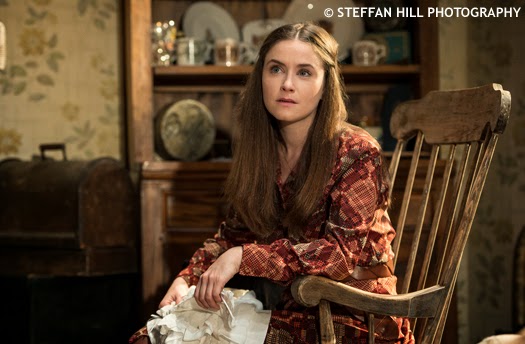
Derry-Londonderry actress Judith Roddy (above) endures another Particle Of Dread as Marian, an extremely troubled soul all too slowly inching her way towards divorce from Paul Mallon's motor mouthed Lenny. Their first exchanges are as damp and unforgiving as the peeling paper and insecure insulation of the walls surrounding them, strongly reflecting the attitudes and accommodation of the time. Both Lenny and Marian are, naturally, cynical. But while he seems loudly laconic, she seems academically apathetic, a "quality" she attempts to put to good use in this atmosphere.
Or should that be atmos-fear? For Marian is haunted by unwelcome visits from the spirit of Lily (the excellent Carol Moore), the late, lifelong resident of the house Marian is trying to claim for herself. "You have no right to be here!" screams Lily to Marian during their first visible encounter. But Marian doesn't even like herself, let alone Lily: her battle with the bottle and the quest to find a roof, any roof, to sleep under, seem like the only things keeping her alive for now. And Roddy intelligently depicts her character's not fully convincing facade; we already get the first hint that Marian has more in common with Lily than she would like to admit.
Roisin Gallagher ratchets up the tempestuous, testing tension as Marian's childhood friend Ruth. Forced to flee into the questionable warmth of Marian's heart and hearth after beatings from her abusive husband become too much to take, she is young Connie Corleone personified: defending an indefensible partner for unknown reasons, other than that he is the only companion she believes she will find at the time. Here Parker's script enters a sticky moral quandary. How much value do Marian's advice - sensible it may be - and "home" have for Ruth, when Marian has not even finalised a divorce or fully settled into her new surroundings herself? But then, Marian is trying to break up an unhealthy relationship as opposed to running away from it, and perhaps Ruth's uncomfortable reactions stem from Marian not telling her what she wants to hear. It's a confident, concise countering of the "moral high ground" quagmire, and it is to Roddy, Gallagher, Parker and Fay's credit that it comes off.
The women of the play have cast such a shadow over events so far that the male actors, Paul Mallon (above) and Will Irvine, have their work cut out for them. But they are up to the task, particularly Irvine, who eventually transcends the initial stereotype of a clueless, comedic hippie. His early "Rhys Ifans in Notting Hill" expressions would be more than enough to raise his profile on their own, but that would be diminishing the effect of his all round character playing - and, for that matter, everyone else's.
Bombshell after bombshell, be they literal or humane, descend on this not so nuclear "family" as the play proceeds, with Marian battling to maintain her composure as the apparent "leader of the gang". She insists that certain possessions and rooms of Lily's must stay untouched to protect her memory. But what the play really appears to suggest is that Marian's actions exist to protect herself: the spiritual sojourns of Lily are taking their toll on someone who simply wants somewhere to live. Pentecost feels as much about the quest for a stable identity as the quest for a stable home. And Marian is not finding it in a metaphorical "hall of mirrors" where her inner demon is reflected in the outer demon of Lily: both women are defined by stubborn, angry facades as their coping mechanisms.
By contrast, the melodies Lenny, a failed musician, plays on his trombone are, coincidentally, as catastrophically cacophonic as The Troubles, while Peter eats muesli. Lots of it. Peter develops a "plague on both their houses" attitude - to him, it's no longer us versus them, but he versus an irrational "it" which he doesn't, or simply doesn't want to, understand. We pity him here - who would want to be in his shoes, especially as he has already been revealed to be one of the "spongers" the government dislikes? His outpouring of emotion on an intimacy starved Ruth earns him a predictable but eventually costly reciprocation.
The parallels keep pouring in as this elegant elegy for times gone by becomes almost too much to bear. Lenny is trying to resurrect ghosts (his musical career, his marriage to Marian) while Marian is consistently haunted by one. Curiosity forces Marian to dig further into Lily's private life, heating up an exchange between spirit and human in which both actresses shine and both personalities' resemblances strengthen.
Without going into too much more detail, it's not stretching things to say that it's quite possible Lily doesn't want Marian in the house because she doesn't want her own life, which she has many regrets over, to be lived out all over again on the same premises. Lily, who lived through a war, waited for the troubles to "do away with her" - but they wouldn't. She had to live on. Like the four humans in the play must live on, albeit with a newly discovered, unpredictable, but undeniably unifying bond.
It is said that a home is full of love and dreams; this house has fallen bricks and beams. Whether anything will amount from the resurrected humanity in the place is anyone's guess. But the overall effect of everything leading up to that point is testament to the strength of the script and acting in the penetrative, penitent Pentecost.
Pentecost runs until Saturday, October 18 in Belfast's Lyric Theatre.Read more...
The stars of Simon Stephens' Punk Rock on their characters, their experiences and the meaning behind the play
Meet William Carlisle, a painfully shy and bright seventeen-year-old boy with something of a "God" complex. He genuinely thinks he's better than everyone else in his Stockport school. An awkward, over-compensatory, nervous, kind, funny and unpredictable soul, William's world will be turned upside down when he falls for new arrival Lilly Cahill from Cambridge.
Lilly herself is far from nervous, but eager to please. She has moved around a lot and finds her new surroundings very welcome. On the outside, Lilly is worldly, cocky, streetwise, opinionated and superior, but inside she hides neediness, loneliness and emotional insecurity. And her very arrival will be the catalyst for the central chain of events in Simon Stephens' Punk Rock.
For almost a month, Belfast's Lyric Theatre has played host to the trials and misadventures of seven confused teenagers at Stockport Grammar School. The tension between William and Lilly, brought to life by Rhys Dunlop and Lauren Coe on their stage debuts, is the nucleus of the play.
Dunlop & Coe, both graduates of The Lir, Ireland's National Academy Of Dramatic Art in Dublin, speak to Si's Sights And Sounds about their roles in and experience of making Punk Rock.
What does Punk Rock mean to you in the context of this play? Personally, I see it as representative not so much of the music, but of the personality that goes into the music; the flip side of good vibrations and teenage kicks.
Rhys Dunlop (William): I agree completely. The children in the play are by no means "punks" but rather share the energy that the music lends itself to. It charges the scenes and play accordingly.
Lauren Coe (Lilly): Definitely. To me, it means anarchy, rebellion, the constant struggle against authority, which is often the main cause of a violent undercurrent in teenagers. It's in these characters' every attitude, vocabulary and the way in which they wear their uniforms. They're trying to carve out an identity for themselves in a world of adults who either show little interest or far too much.
Dunlop: Simon Stephens, the writer, inserted songs into the script for the top of each scene, which really do give a unique dynamic to what follows them. He said he wanted to give audiences the feel of being at a rock concert, and I believe the explosive energy of the music between scenes helps to achieve that.
Coe:Punk Rock is also hugely about hormones. Sex and lust are massive themes within the play, to the point where pent-up desire is almost unbearable, and the action of sex provides some sort of animalistic release from the systems of emotional instability.
How did you decide to approach playing your characters?
Dunlop: Because, to me, the play's text is so good, I found that if you just trust the language and punctuation, then the character takes care of itself. It is often said that character is as character does, or says. I think that rings true for William in Punk Rock.
Coe: Lilly has never had a place to call home, therefore she has no reference point for her identity. So she has created a shield of bravado around her, to feel protected. At one point, she reveals to William that she cuts and burns herself; I spent a bit of time on self-harm forums as research, to get an understanding of the self-harmer's psyche.
But what I found really interesting was that a lot of sufferers said their self-harm wasn't an attempt at suicide, but a way of dealing with emotional pain: coping and surviving. To me, Lilly is a survivor. The animals she uses to describe herself in the play – a wolf, a leopard, a rhinoceros, a gazelle, a cheetah, an eagle and a snake – are all predatory. They survive because they are clever, strong and ferocious, just like her.
Dunlop: Of course, there are also a number of technical obligations regarding preparation; dialect, back story, social & cultural context, to name but a few. Thankfully we explored a lot of this in the rehearsal room. (Director) Selina Cartmell invested a lot of time in creating the world of the play together as an ensemble and sharing our research materials with the group. We also worked with dialect coach Brendan Gunn right from the start of rehearsals, which was massively important.
How do you view the compelling dynamic between William and Lilly in Simon Stephens' script? Having seen and reviewed the play myself (read the review here), I'm convinced that one would struggle to get by without the other...
Dunlop: I think they are very similar in many ways, despite their possible diametric opposition on the social ladder. They see the world through the same frame. William finds an equal in Lilly, someone worthy of his presence, conversation and indeed life. I mean that in a marital sense as opposed to a sacrificial one.
Coe: In the rehearsal process, Selina Cartmell talked a lot about the idea of matter versus antimatter. She asked, were our characters matter (positive) or antimatter (negative)? Lilly knows that William is, in many ways, part of the same "antimatter" tribe as her; explosive and dangerous. He notices her scars. They understand each other within the "academic zoo" of Stockport Grammar School. They both have a contempt for the mainstream and they feed off each other, and need this connection to validate themselves. They are two dangerous energies, and when they collide, it detonates and causes a tragic outcome.
Dunlop: Lilly is the catalyst for all that happens in the play, the kerosene that sets William's journey alight and ultimately causes it to burn out of control. You're right, they do struggle to get by without the other, or at least William does, further evidenced in the play.
Coe: I think Lilly knows she's playing with fire with William. She knows he really likes her, but she can't resist feeding the flame because her own desperate need to feel wanted makes her ask for more. Her flirtations are overt, so it's no wonder that William builds up the confidence to ask her out, thinking she'll say yes.
But, of course, it's not all about William and Lilly. There are five more characters in this Stockport Breakfast Club – bully Bennett, cynical Cissy, sporty Nicholas, idealistic Tanya, and extremely geeky Chadwick. How do you think your characters perceive them?
Dunlop: Intellectually, William acknowledges Chadwick's brilliance, and he is indeed a friend. However, he still positions himself above Chadwick in his head, due to his social background. I think William hates Nicholas, because he's probably everything William wants to be: athletic, good looking and charming, with the power and social position to step in and stop the bullying in the play. William admires and is jealous of the relationship that Cissy and Bennett have. He wants a girlfriend; if he has one, he believes that he will be seen as the alpha male of the group, not Bennett.
Coe: Like William, Lilly has a superiority complex. She seems to have something to say about everyone; she tends to be judgmental. After being at the school for merely a week, she's not entirely sure she trusts Chadwick, nor likes him: "He's not normal". She also says Bennett does her head in, and I don't think she's alone there! But I think that when Bennett becomes increasingly cruel to Chadwick, Lilly feels really bad about judging Chadwick so quickly. She's very contradictory, which makes her a very truthful teenager and really enjoyable to play.
Dunlop: As William free falls through the play, I think he is trying to make his mind up about how he perceives everyone else. He gravitates to and from them all at different points in the play, suggesting a dissociation with the group and arguably society.
Coe: I think Lilly's relationship with the other girls is an interesting one. They have a laugh, but I don't think she would be friends with either of them without the other. Neither of the two girls are exactly Lilly's type of person: Cissy is a girly girl, very bitchy, and Tanya's a bit hyperactive, though I think Lilly admires her kindness. Lilly has a strong sexual chemistry with and physical attraction to Nicholas... in my opinion, Nicholas's level-headedness and normality provide Lilly with positivity, a respite from her own mental health issues. How challenging have both of you found this, your stage debut?
Dunlop: Massively challenging and equally rewarding. I've been so lucky to work on such an amazing character with and an incredible company. Long may it continue! Coe: A fantastic experience. It's been really comforting to work with two of my peers from drama college and a cast of other people from our age group. We've had a lot of fun together and I'll miss them a lot. I guess the biggest challenge is the length of the run, and the size of the theatre – you need a massive amount of stamina! Lilly's a very complex creature as well, so there was a lot of problem solving along the way too.
Are you pleased with the reception so far, both from audiences and critics?
Dunlop: It's been great that the play has been received so well. I think this is a really exciting piece of work and fearless programming from Jimmy Fay. I just hope that it gets supported by good houses so that we can earn and ultimately expect new, bold and exciting work like this from now on.
Coe: Responses have been incredible. The play really seems to blast a hole in the centre of people, which I'm sure was Simon Stephens' intent. We've had very vocal audiences too – lots of laughter, applause in random places and even a few "Oh God" cries!
Contemporary theatre is so important to me, as I believe theatre should always be reflecting the present day real world. Hopefully Punk Rock will be a step towards more new writing being programmed in Irish theatres, and drawing new, younger audiences.
Punk Rock runs in Belfast's Lyric Theatre until Saturday September 6 2014, with a special performance featuring a post-show discussion with writer Simon Stephens on Thursday September 4.Read more...
Belfast's Lyric Theatre stages an unpredictable mosaic of a play, an archetypal reflection of the titular music
Nothing in the trailers, the title or even most of the show itself can really prepare you for what to expect from Simon Stephens' Punk Rock. Directed by Selina Cartmell, the production, set in a school in Stephens' native Stockport, is framed not as a predictable chronicle of the titular music but more as a series of discussions amongst obviously too-cool-for-school children, punctuated by thunderous musical interludes. It is less about the characters finding themselves and more about the characters being themselves, remarkably avoiding most obnoxious pitfalls to become a true eye-opener for its audience.
Punk Rock is, in many ways, The Stockport Breakfast Club; John Hughes' classic filtered through a undetained Grunge Hill lens into something edgier, more fractured and more troubling. Early exchanges are spunky, relatable and full of bite, the genuine intelligence and obviously nerdy appearance of apparently likeable William (Rhys Dunlop) unconvincingly masking his clear attempts to pull the moves on new girl Lilly (Lauren Coe). While Lilly, a typical fish out of water from Cambridge, seems happy to pal and play along with him, she looks a tough nut to crack. Amongst the five other adolescents – bully Bennett (Ian Toner), cynical Cissy (Aisha Fabienne Ross), sporty Nicholas (Jonah Hauer-King), idealistic Tanya (Laura Smithers) and extremely geeky Chadwick (Rory Corcoran) – Lilly seems equally at ease, her presence offering a good opportunity for everyone else to forget about their upcoming mock exams.
Punk Rock's intentionally muddled narrative is given passion and spirit by a truly excellent cast, six of whom (Dunlop, Coe, Ross, Hauer-King, Smithers and Corcoran) are making their professional stage debuts. Admirably, Stephens and Cartmell give their "class" plenty of room to be expressive; the tantalisingly kinetic opening dialogue is by no means a predictor of the haphazardly fascinating tone of the play.
The world of this Stockport school is one of swearing, abuse, hatred and even violence, laden with brief emotional releases and clouded by mistrust. For example, Bennett's bullying, primarily of Chadwick, masks sensitive cowardice, brought to the forefront when little sister Lucy asks him to come home. Sensible Lilly never feels like who she claims to be, her "proper" politeness and kind-heartedness disguising self-harm and self-hatred. Understandable though it is that she rebuffs William's advances, when she claims she "loves" Nicholas, we never really believe her.
Only the impossibly clever Chadwick feels wholly honest with himself. Most revelatory are his creepily nonchalant expressions, particularly during a “monologue of doom” about the human race. You don't see Chadwick as you want to see him or how he wants you to see him; you see him as he is. And you suspect the other characters envy him for it.
What could be a possible hindrance – the lack of an obvious heart in central character William – is turned into a strength by actors Rhys Dunlop and Lauren Coe. In what amounts to a minor tour de force, Dunlop transforms a series of tics and traits into a frantic soul given a conscience by Coe's watchful Lilly. She might be there for him reluctantly, but one senses that she needs to be there; her refusal of William's romantic gesture, combined with his inability to accept that she does not love him, will ensure that the play takes a macabre turn for the ticking time bomb that is William and everyone around him.
The shocking and bafflingly unreal conclusion tempts one to raise the theory that the whole play may well have been happening inside William's head. But it is more logical to assume that Punk Rock totals up to the desperate, doomed, depressed rantings of a boy who wants to "choose life" but can't, or won't, therefore he doesn't. A potentially endearing central character has become a figure of outright madness in a deranged denouement that seems far, far away from any good vibrations or teenage kicks.
But then, one realises that Punk Rock really has been faithful to the titular music: it is a depiction of the archetypal moods that reflect the basis on which punk was founded. One sees the characters as they are intended to be seen: Lilly, the heart; Bennett, the bravado; Lucy, the innocence; Nicholas, the jock; Chadwick, the brains; Tanya, the optimism; Cissy, the apathy, and William, the crazed, confused soul. As a story, Punk Rock is as confusing and frustrating as the adolescence it depicts; as a metaphor, it is quite spectacular, an affecting emotional mosaic. Punk Rock runs in Belfast's Lyric Theatre until Saturday September 6 2014.Read more...
Freelance journalist, writer and photographer currently based in Derry-Londonderry. Especially enjoys discussing, and writing about, culture and football.